
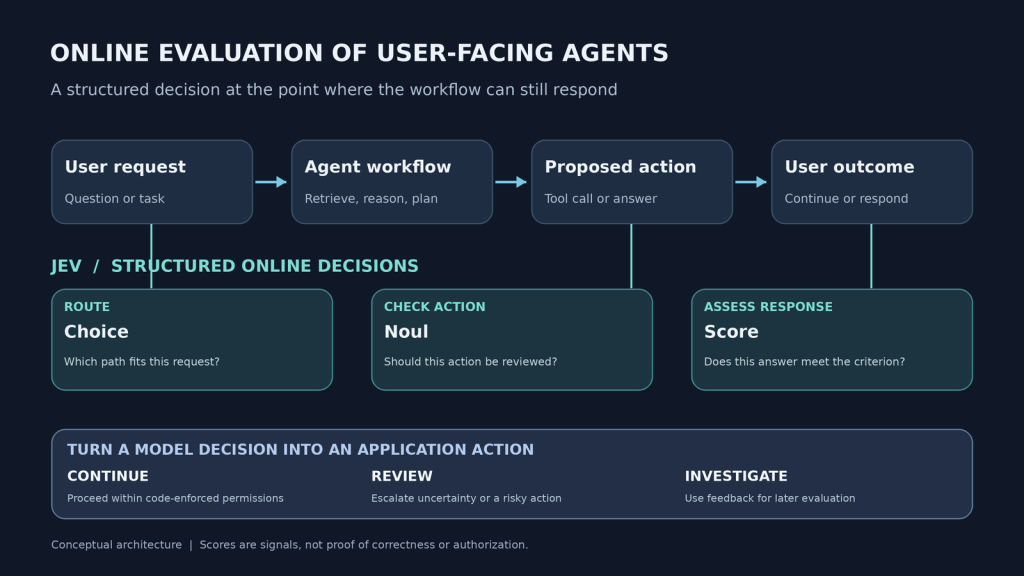
A user-facing agent is not a single model answer. It may retrieve information, choose a tool, use that tool, and then explain the outcome. Evaluating only the final response misses important decisions along the way. Did the agent choose an appropriate action? Did it have enough evidence to answer? Should a tool call be reviewed before it runs?
Those questions are especially difficult in an online setting. The evaluation has to fit into a live workflow, where every additional model call can add latency and cost. This is why I find decision models such as Jev technically interesting. They are designed to return a bounded decision rather than generate a long critique, making it possible to evaluate a specific part of an agent’s behavior at the point where the result matters.
Turn an evaluation question into a typed decision
A conventional LLM judge can produce a helpful explanation, but a production workflow often needs a small, actionable result. Jev offers three output shapes: a Choice among predefined options, a numeric Score, or a yes-or-no Noul. Each shape gives downstream code a clear decision to handle.
Suppose an application needs to check whether an agent’s answer is supported by retrieved evidence, whether a proposed tool action matches the user’s request, or whether a conversation should be escalated for review. Jev can return a category or score, and the application can take a defined next step.
A typed output reduces the work of extracting a decision from free-form text. It also makes it easier to version evaluation questions and compare like with like. It does not make the judgment deterministic or guarantee that the answer is correct. The evaluation policy and its categories still have to be designed and tested.
Put evaluation where it changes the workflow
Online evaluation can serve different purposes at different points:
- Before the agent runs: Classify an incoming request to select an appropriate route or identify a request that needs special handling.
- Before an agent takes action: Evaluate a proposed tool call or other consequential step while there is still time to pause or escalate it.
- After an agent responds: Score a bounded quality question, such as whether the answer appears grounded in its available evidence, and route concerning cases for review.
The value of a fast decision layer is not only that it produces another metric. It can create a timely signal that the application can use to continue, defer, or investigate. That is particularly useful when an agent interacts with users continuously and waiting for a later batch evaluation would miss the opportunity to intervene.
I would keep the evaluator’s role narrow. An evaluator can flag a potential mismatch or recommend review, but the application must still enforce permissions, validate tool arguments, and decide which actions are allowed. A model score is not a substitute for an authorization check.
Keep the evaluator’s overhead proportionate
Running a large generative judge after every user message or agent step may be impractical. The evaluator itself can become a source of latency, token expense, and additional failure modes. Jev’s structured, non-generative approach is appealing because it is intended for short classification and scoring decisions rather than long-form reasoning.
That is an architectural benefit to investigate, not a benchmark I can assume. The real question is whether the end-to-end workflow meets its latency and cost requirements while producing sufficiently useful decisions. I would measure the full path, including network time, retries, timeouts, fallback handling, and any human review the evaluation triggers. A fast model call does not help if its integration slows or destabilizes the user experience.
A bounded decision model can also make selective evaluation easier. Not every event needs the same depth of review. An application could use a cheap initial check to route ambiguous or consequential cases to a deeper evaluator or a person. That design can reserve more expensive analysis for the moments when it adds value. Its benefit depends on whether the first-stage decisions reliably identify the right cases to escalate.
Turn live judgments into useful evaluation signals
If I am evaluating an agent over time, I need to know what was assessed and which version of the question produced the decision. A structured result can be recorded with a limited set of safe metadata: the evaluation category, policy version, decision, review status, and relevant timing. Aggregated over appropriately handled cases, those records can help reveal changes in the agent’s behavior or identify categories that deserve an offline regression test.
But an evaluator’s score is not ground truth. A high confidence value should not be treated as proof that a judgment is right for every user population or workflow. Jev returns probabilities with its decisions; I would check how well those probabilities correspond to reviewed outcomes for the task at hand. I would also look for false blocks, missed problems, uncertain cases, and delayed feedback. Otherwise a dashboard can show stable-looking scores while important failures go unnoticed.
Privacy matters here as much as measurement. User prompts, retrieved content, and tool arguments may contain sensitive information. An online evaluation design should minimize what is sent to the evaluator and what is retained in logs. It should be clear what happens when a check cannot run: fail closed, fail open, or defer to review, depending on the action’s risk.
The benefit is a better decision point
Jev’s technical appeal for online agent evaluation is the combination of a bounded output contract and an architecture intended for quick classification or scoring. That can make it easier to place evaluations in a live user workflow, route uncertain cases, and collect comparable decision signals without requiring a free-form LLM critique at every step.
I would still evaluate the evaluator. Does it identify the failures that matter? Does it interrupt legitimate users too often? Is the overhead acceptable in the complete application? Can a human or another process review its mistakes? The benefit is not that a model can pronounce an agent safe. It is that a well-defined evaluation question can lead to a timely, testable decision while the agent is actually being used.


Leave a Reply