
My current work investigates how machine-learning models can forecast future biological and clinical states while remaining structurally interpretable and explicit about uncertainty. The projects below span graph neural networks, medical imaging, probabilistic modeling, calibrated prediction, and computer vision.
Research workflow: In Agentic AI Researcher, I explain how I am building the Twin Forge, a Hermes research team with independent verification, Obsidian memory, and human review for my digital-twin uncertainty research.
Endpoint-Calibrated Spatial Graph Rollouts for Functional Tumor Volume Forecasting
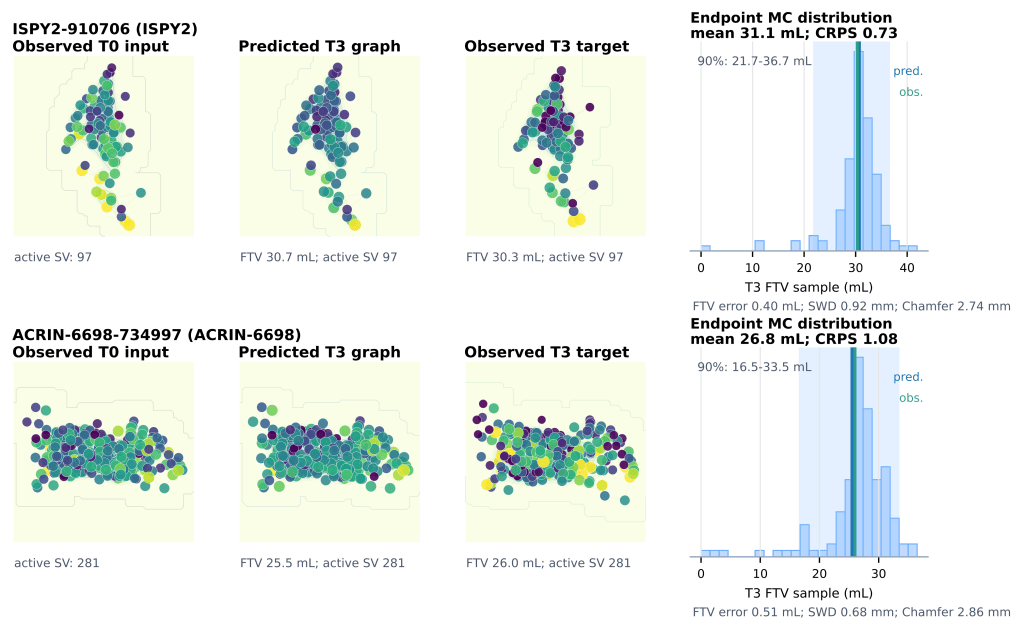
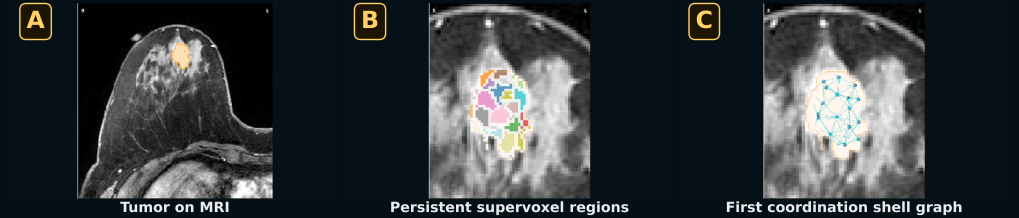
I developed a graph-native framework for forecasting regional tumor state and functional tumor volume from longitudinal breast DCE-MRI. The model advances registration-consistent tumor supervoxel graphs and combines scheduled-sampling message passing with residual Monte Carlo simulation and bucket-conditional conformal calibration.
Across five patient-held-out folds containing 758 I-SPY2/ACRIN-6698 patients, the retained hybrid-edge model reduced deterministic T0-to-T3 FTV mean absolute error from 12.88 to 4.63 mL. These results are an internal cross-validated evaluation rather than an untouched external test.
Code: https://github.com/mirisr/breast-dce-mri-graph-rollouts
Tumor-Graph Deep Learning from Pretreatment DCE-MRI
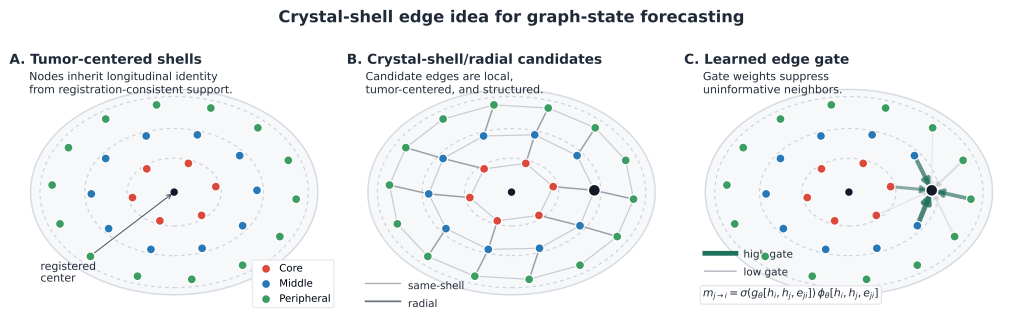
I developed a pretreatment-to-presurgery tumor-graph model that combines frozen ResNet-18 image embeddings with crystal-shell edge-gated message passing. From pretreatment imaging, its primary forecast describes regional enhancing-tumor state and functional tumor volume with a patient-conditioned conformal interval. A separate secondary pathologic complete-response analysis also uses observed early-treatment and inter-regimen features, so I do not present its pCR score as a pretreatment-only prediction.
The model was trained on 556 I-SPY2 patients, with all model and uncertainty choices frozen before evaluation on 202 nested ACRIN-6698 patients held out from training and calibration. This work is currently documented as a double-blind manuscript draft.
Read the crystal-shell graph forecasting case study, including held-out results and limitations →
Stochastic Digital Twin for Neoadjuvant Chemotherapy
I am developing a stochastic reaction-diffusion framework with sequential Bayesian calibration for uncertainty-aware breast-cancer treatment research. Current work focuses on tempered EnKF/Liu–West assimilation, reduced-rank proliferation fields, posterior predictive distributions, scalar-FTV observation models, and explicit identifiability limits.
This research is in progress and does not currently claim validated treatment optimization, clinical utility, or physical longitudinal spatial correspondence across incompatible imaging frames.
Automated 2D Registration for High-Multiplexity Embryo Imaging
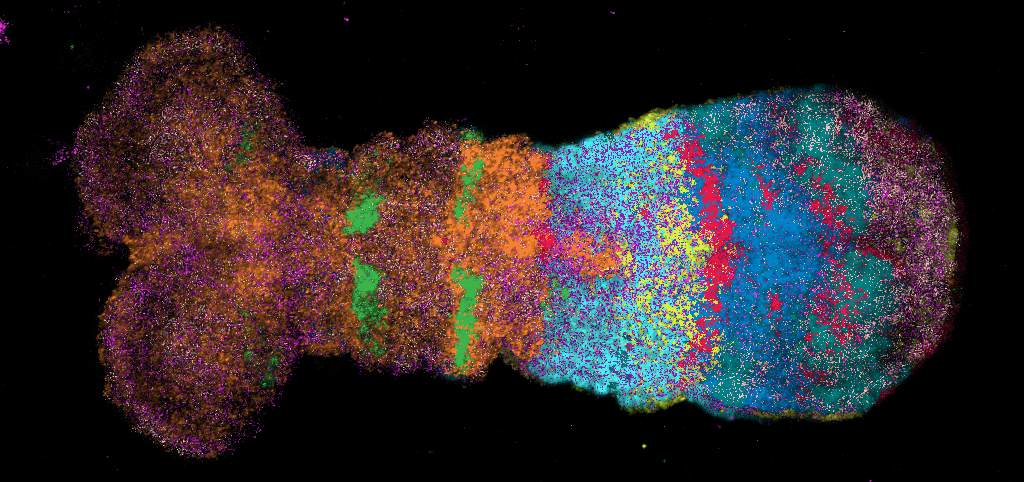
I designed and implemented the computer-vision pipeline used to register sequential fluorescence-imaging rounds of the same *Tribolium* embryo. The workflow normalizes and smooths the DAPI reference channel, isolates and morphologically cleans the embryo mask, estimates an in-plane similarity transform for translation, scale, and rotation, and applies the transform identically to the corresponding gene-expression channels.
This work contributes to the manuscript *High-multiplexity imaging reveals distinct modes of translating time into space during embryonic patterning*, revised and resubmitted to *PLOS Genetics* in September 2026.
Code: https://github.com/ezzatelsherif/tribolium-sequential-imaging
Earlier Work: Nested Reasoning for Autonomous Agents
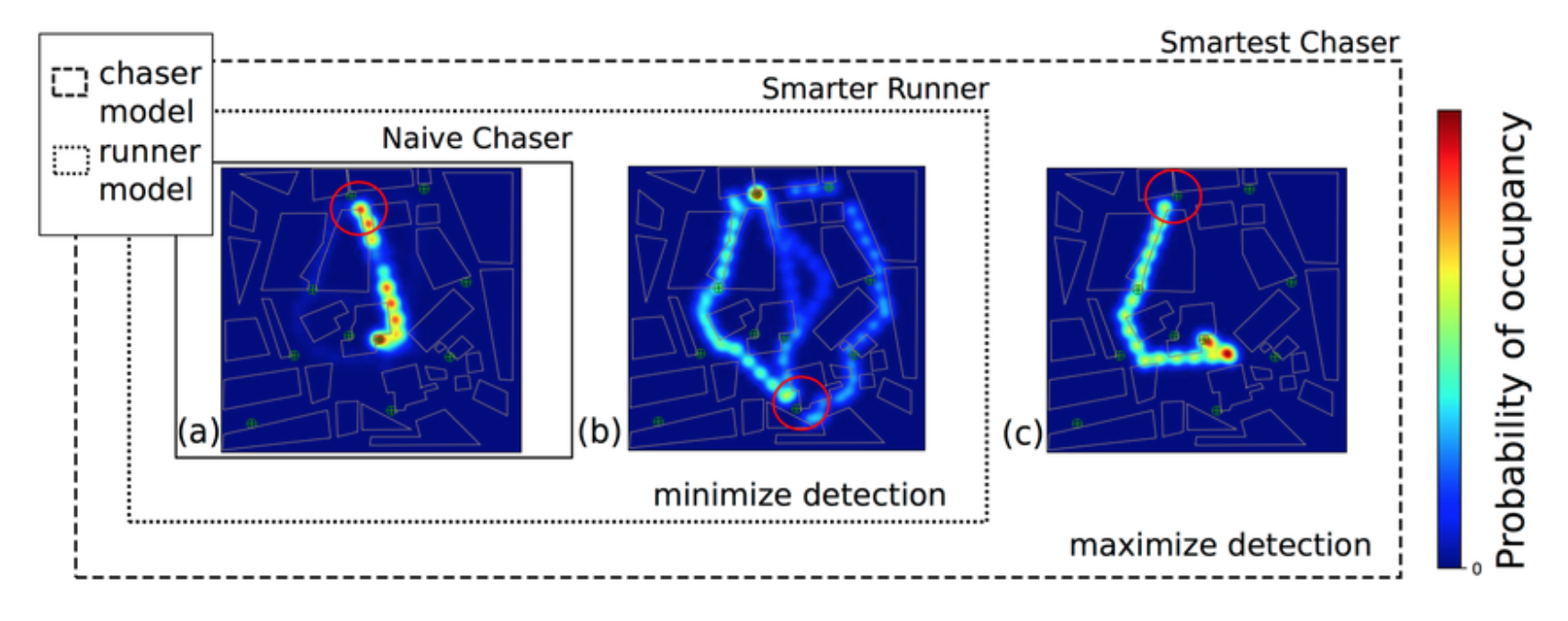
My earlier research developed planning-as-inference methods in which autonomous agents use nested probabilistic simulation to reason about other agents’ plans. The work combines probabilistic programs with field-of-view calculations, path planners, and pursuit-evasion environments.
Paper: https://arxiv.org/abs/1812.01569
Selected Publications and Manuscripts
1. J. Garcia-Guillen, M. Ahmadi, T. Frimpong, I. Seaman, et al. “High-multiplexity imaging reveals distinct modes of translating time into space during embryonic patterning.” Revised manuscript resubmitted to *PLOS Genetics*, 2026.
2. I. R. Seaman, J.-W. van de Meent, and D. Wingate. “Nested Reasoning About Autonomous Agents Using Probabilistic Programs.” arXiv:1812.01569; spotlight at the ICML 2019 Workshop on Generative Modeling and Model-Based Reasoning for Robotics and AI.
3. I. R. Seaman. *Probabilistic Programming for Theory of Mind for Autonomous Decision Making*. Master’s thesis, Brigham Young University, 2018. https://scholarsarchive.byu.edu/etd/6826
4. Y.-K. Ng and I. Seaman. “Personalized Table-Top Game Recommendations.” *IEEE ICTAI*, 2017, pp. 396–403. https://doi.org/10.1109/ICTAI.2017.00068
5. E. Tan, I. Seaman, H. Leung, and Y.-K. Ng. “Making Personalized Movie Recommendations for Children.” *18th International Conference on Information Integration and Web-Based Applications & Services*, 2016, pp. 96–105.
6. I. Seaman and C. G. Giraud-Carrier. “Prevalence and Attitudes about Illicit and Prescription Drugs on Twitter.” *IEEE ICHI*, 2016, pp. 14–17. https://doi.org/10.1109/ICHI.2016.98

